Saturday, June 11, 2016

Congress Denies Mailmen a Quorum

http://www.bloomberg.com/news/articles/2016-06-09/congress-denies-mailmen-a-quorum

The USPS has eight open seats on its board, thanks to Senate politics.


After a decade on the U.S. Postal Service Board of Governors, James Bilbray is ready to go. “I turned 78 on May 19,” says Bilbray, the board’s chairman. “I’m getting old. I’m getting tired.” Yet Bilbray, whose term was extended after it expired last December, fears he’ll leave a vacuum at the USPS. The U.S. Senate has refused to confirm any of President Obama’s appointees to the Board of Governors since 2010.
The board, which is supposed to have 11 members, currently has only three: Postmaster General Megan Brennan; her deputy, Ronald Stroman; and Bilbray, a former Democratic congressman from Nevada who was appointed by George W. Bush. Unless something changes, there will be only two at the year’s end, when Bilbray’s extension is up.
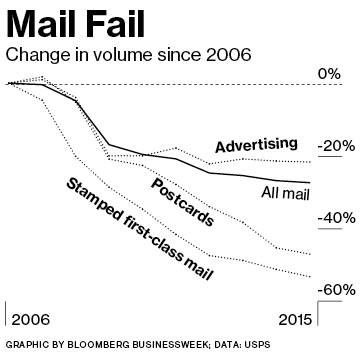
The USPS Board of Governors may seem like another nondescript oversight body in Washington made up of lawyers, ex-politicians, and businesspeople with a surplus of free time. But the board, whose members earn a $30,000 annual salary, keeps watch over the world’s largest postal service, which made $69 billion in revenue last year, although it struggled with a $5 billion deficit. That was because of a legally mandated obligation to set aside money for the health-care benefits of its future retirees. It’s seen 28 percent of its volume vanish in the past decade but still delivered 154 billion pieces of mail last year.
Obama tried to remedy the situation by nominating five people to the USPS board in 2015. Two were Republicans: James Miller, Ronald Reagan’s director of the Office of Management and Budget; and Mickey Barnett, a former Republican state senator from New Mexico. Obama also named three Democrats: Stephen Crawford, a professor at George Washington University; David Bennett, a former aerospace executive; and David Shapira, chairman of the Giant Eagle supermarket chain.
The Senate has yet to vote, because there are holds on the nominations. Typically, senators don’t discuss such backroom maneuvers, but in this case one has: Vermont Senator Bernie Sanders. According to his senior policy adviser, Warren Gunnels, Sanders is blocking the two Republicans—Miller because he wants to privatize the Postal Service, and Barnett because of his ties to the payday loan industry. Sanders is also opposed to Crawford, who’s proposed cutting home delivery and instead allowing people to receive scanned copies of their letters electronically, as they do in Switzerland.
By putting a hold on three appointees, Sanders prevents all five from being confirmed, because the Republicans who control the Senate will hold a vote only on all five as a package. “Senator Sanders thinks no board is better than a bad board,” Gunnels says. It’s a position shared by the American Postal Workers Union, which has endorsed Sanders’s presidential run. “The APWU has been very dissatisfied with the nominees that have come out of the White House,” says Mark Dimondstein, the union’s president.
Before it lost its six-member quorum in late 2014, the board created what it calls a “temporary emergency committee” comprising the remaining members to approve the USPS’s spending and other major policy decisions. It’s unclear whether the committee will still be empowered to do so when Bilbray leaves. “According to our legal opinion, you have to have one governor appointed by the president and confirmed by the Senate,” Bilbray says. A USPS spokesman disputes this, saying the committee can continue to function even if its only members are the postmaster general and her deputy.
Bilbray says he’s skeptical of rumors that Sanders may withdraw his hold after the Democratic National Convention in July. According to Bilbray, Sanders told him he wouldn’t relent until the USPS reopens 141 mail processing plants that it’s either closed or consolidated in recent years to save money. “Bernie wants us to go back and reopen all those mail processing centers—even the ones we’ve leased,” Bilbray says. “It would cost us around $2 billion.” Gunnels says Sanders doesn’t want all the plants reopened, but he definitely wants some of them up and running.
What happens next year when a new president is sworn in? Whether it’s Hillary Clinton or Donald Trump, there’s likely to be more gridlock. Even if Sanders withdraws his objections, Bilbray says, the unions have told him there are other senators willing to tie up the appointment process indefinitely. “That’s why we’re up a creek.”
The bottom line: The last presidential appointee on the USPS Board of Governors retires in December, and there’s little prospect of replacing him.

Sunday, May 22, 2016

Making no cents: Postal Service's bad business model is embodied in recent rate decrease

http://www.msn.com/en-us/money/markets/making-no-cents-postal-services-bad-business-model-is-embodied-in-recent-rate-decrease/ar-BBtftj7

Several days after the U.S. Postal Service dropped the price of sending a one-ounce letter from 49¢ to 47¢, almost 40 people stood in line at the Franklin D. Roosevelt Station, a post office in Manhattan, fiddling with their smartphones, making conversation, or just staring into the middle distance. Perhaps they were there for discounted stamps? A clerk at the window laughed at the suggestion. “Two cents?” she said, rolling her eyes. “Are you kidding? It’s the same as always.”
She had this much right: The public didn’t clamor for the April 10 stamp price decrease, the first in 97 years. U.S. postal rates are among the lowest in the industrialized world. In 2015, according to the USPS, it cost 96¢ to mail a 1-ounce letter in Britain and $1.51 to send one in Denmark, which is about 200 miles across at its widest, roughly 3,800 miles less than the distance from Anchorage to Palm Beach. Until recently, Spain was the only nation in the developed world that charged less; now the U.S. and Spain are tied at the bottom.
It’s not as if the Postal Service was making too much money. It lost $5 billion last year, and with the reduction it will likely lose an additional $2 billion a year. However, the Postal Regulatory Commission, which oversees the USPS, insisted on it. To understand how something so seemingly nonsensical could happen, it helps to know something about the agency’s history.
The post office has been around for 240 years. In addition to delivering mail, it’s sparked a lengthy conversation about the need to run it like a business. For much of its history, its budget was controlled by Congress, which also set the price of stamps. Despite the pleas of postmasters general, elected officials were inclined to avoid rate hikes to keep their constituents happy, even as they handed out salary increases to postal workers.
The results were predictable. From 1932 to 1958, the price of a first-class stamp stayed fixed at 3¢, and the post office was starved for capital. Arthur Summerfield, a former Chevrolet dealer from Flint, Mich., was horrified when he took over as Eisenhower’s postmaster general in 1953. “Almost everywhere work was being done with shopworn equipment in run-down, over-crowded, poorly lighted postal buildings constructed years before,” Summerfield recalled in his memoir, U.S. Mail.
When he departed in frustration eight years later, the mail system was beginning to unravel. In 1966, the federal government was forced to shut down the enormous Chicago post office for 10 days because clerks were overwhelmed by a pre-Christmas junk mail rush. The Saturday Review called it “the most incredible snarl in mail movement since the inauguration of the U.S. postal system—and, in the view of some experts, a nightmarish preview of mail service horrors that lie ahead.”
In response, President Lyndon Johnson appointed a commission in 1967, led by Frederick Kappel, the recently retired chairman of AT&T, to come up with a plan to repair the system. He and his fellow commissioners, who’d been recruited from General Electric, Campbell Soup, Bank of America, and Harvard Business School, were dismayed when they learned that the postmaster general had no say over postal rates.
The Kappel Commission called for the creation of the U.S. Postal Service, a so-called government corporation, which, in theory at least, would be free from outside meddling. In 1970, Congress adopted the plan. Control over stamp prices was almost within reach of the post office, but, at the final hour, Congress created an outside body called the Postal Rate Commission, which would have the power to approve or reject any proposed price increases. The rate commissioners saw it as their mission to make sure the USPS, which had a monopoly on letters and junk mail, didn’t gouge the American public.
The rate commission destroyed the dream of a more businesslike Postal Service. When the USPS wanted to increase its rates by a few cents, the commission often took more than a year to reach a verdict.
Every time the USPS tries to operate like a real company, government happens
The system’s flaws became clear when a businessman became postmaster general. In 1988 the USPS Board of Governors gave the job to Anthony Frank, the shrewd, charismatic former chief executive officer of First Nationwide Bank, which he’d turned into the sixth-largest savings and loan in the U.S. “The Postal Service is the biggest management challenge in the U.S., maybe the world,” Frank told Fortune early on. He wasn’t exaggerating. In many post offices, clerks were still sorting mail by hand as they had done under Benjamin Franklin, America’s first postmaster general.
Frank embarked on a long-overdue plan to have 95 percent of the mail sorted automatically by 1995. However, modernization came with a $5 billion price tag, and the USPS slipped into the red after several years of surpluses. It was one thing to automate the mail, but Frank was harder-pressed when it came to cutting costs. One reason: The Postal Service’s union contracts had no-layoff provisions. Frank tried to erase the deficit by increasing the price of sending a first-class letter by 5¢, to 30¢, but the Postal Rate Commission would approve only a 29¢ stamp. Frank argued this wasn’t enough to restore the agency to profitability and that a 29¢ stamp would force the USPS and its customers to use a lot more pennies; the only beneficiaries of that would be Chilean copper miners. He returned to the private sector in 1992.
His successor, Marvin Runyon, a former Ford executive, pleaded with Congress for more freedom, too. “FedEx and UPS can offer volume discounts and do it quickly,” he lamented. “We can’t. You can bring a child into the world faster than we can price a new product and bring it to market.” Runyon didn’t get his wish and departed in 1998. Since then, the USPS board has relied on lifelong employees who know a lot about delivering mail but have sometimes lacked the vision of outsiders like Frank and Runyon. What private-sector luminary would want to run an operation that can’t price its own products?
After a certain point, political leaders in Washington realized this was absurd. In 2006, Congress passed a law allowing the Postal Service to raise prices on letters and junk mail with a minimum of fuss as long as they didn’t surpass the inflation rate. But there was a catch: Congress wanted to make sure the USPS would have enough money to pay for the health care of its employees when they retired. So it made the USPS start setting aside $5 billion a year to fund these future expenses. Then, in 2008, the economy collapsed, which prompted many more Americans to pay their bills online. The amount of mail handled by the USPS has dropped by 28 percent in the past decade, and it has suffered extraordinary losses, exacerbated by the onerous legal requirement to prefund its retiree benefits.
And because inflation has been low, the USPS has been restricted in how much it can raise its prices. In 2013 it appealed to its regulator, now known as the Postal Regulatory Commission, for an emergency first-class stamp price increase of 2¢, which would exceed the inflation rate. The PRC approved it, but only until the USPS collected $3.2 billion, the amount of revenue the commission calculated had been lost when mountains of mail evaporated during the recession. Never mind that the lost volume from the economic crisis is unlikely to come back.
The price increase stabilized the USPS’s finances; it would have been profitable last year if not for the retiree prefunding albatross. Then the Postal Service had to give up the 2¢. The USPS wants to restore the emergency hike and make it permanent, and has appealed to Congress to get around the PRC. But behind the scenes, the catalog companies and nonprofits that flood our mailboxes are campaigning against it, saying the USPS needs to cut costs. Meanwhile, postal workers are driving 25-year-old trucks, and letters and greeting cards are arriving later and later. A 6¢ increase might help erase the USPS’s deficit and pay for new trucks. Even at 55¢, the price of sending a 1-ounce letter anywhere in the U.S. would be one of the great bargains on earth. Unfortunately, its customers would still have to stand in long lines. At the Franklin D. Roosevelt Station, a clerk went on a break, leaving her window untended. Before she did, she sang the refrain from Donna Summer’s She Works Hard for the Money. Her co-workers laughed. Nobody in line did.
Leonard is the author of Neither Snow nor Rain: A History of the United States Postal Service, published this month.

Friday, May 13, 2016

U.S. Postal System Hurtles Toward Financial Restructuring

http://247wallst.com/services/2016/05/10/us-postal-system-hurdles-toward-financial-restructuring/

The U.S. Postal Service (USPS) lost another $2 billion in its second quarter, as it continued careening toward insolvency. The management of the organization used the description “serious,” despite the belief of Postmaster General and Chief Executive Officer Megan J. Brennan that operations can be improved. Regardless of the optimism, a restructuring likely will be necessary, which means tens of thousands of layoffs, post office closings and delivery cuts to four days. These measures have been discussed before.

The USPS blames its problems on future retirement, which is fair. According to management:
Controllable income for the quarter was $576 million compared to $313 million for the same period last year. Calculation of controllable income takes into account the impact of operational expenses including compensation, benefits and work hours; but does not reflect factors such as the legally-mandated expense to prefund retiree health benefits (see Non-GAAP Financial Measures table on following page for full description).
Although non-GAAP measures are misleading, the sum of $1.454 million represents total workers’ compensation expense.
Otherwise:
The U.S. Postal Service reported operating revenue of $17.7 billion for the second quarter of fiscal year 2016 (January 1, 2016 – March 31, 2016), an increase of $788 million or 4.7 percent over the same period last year. The increase was primarily due to an 11.4 percent increase in Shipping and Package volume and pricing strategies.


Also:

Net loss for the quarter was $2.0 billion compared to $1.5 billion for the same period last year. The change in net loss was most significantly impacted by a $547 million unfavorable change in the workers’ compensation expense as a result of interest rate changes – a factor outside of management’s control.
Not nearly good enough to save the USPS in its current form.

Wednesday, January 13, 2016

Bernie Sanders's Highly Sensible Plan to Turn Post Offices Into Banks

http://www.theatlantic.com/business/archive/2015/10/bernie-sanders-lets-turn-post-offices-into-banks/411589/

In an interview with Fusion’s Felix Salmon the day after last week’s Democratic debate and published Tuesday, Senator Bernie Sanders discussed the marquee features of democratic socialism he’s been tirelessly calling for during his presidential campaign: higher taxes for the wealthiest Americans, an increased minimum wage, and breaking up the biggest Wall Street banks.
Salmon also raised a possibility that has not been as prominent in Sanders’s stump speeches, but animates him nonetheless: turning the U.S.’s post offices into banks. Sanders:
If you are a low-income person, it is, depending upon where you live, very difficult to find normal banking. Banks don’t want you. And what people are forced to do is go to payday lenders who charge outrageously high interest rates. You go to check-cashing places, which rip you off. And, yes, I think that the postal service, in fact, can play an important role in providing modest types of banking service to folks who need it.
It’s something Sanders alluded to in a 2014 Wall Street Journal op-ed, and it’s not even the craziest idea proposed to save the USPS—a report last year explored the implications of turning post offices into hubs for 3-D printing.
In fact, Sanders’s idea is quite sensible. “Postal banking”—which just means that post offices run savings accounts, cash checks, and perform other basic financial services—is common in most of Asia and Europe, and only about 7 percent of the world’s national postal systems don’t offer some bank-like services. Postal banking is a really good way to reach people who haven’t had access to standard savings accounts. One estimate figures that more than 1 billion people have used post offices for making deposits.
The reason why this would be so useful in the U.S. is that somewhere between 20 and 40 percent of the population has to rely on check-cashing or payday-lending services, which in some places charge usurious rates that send people into spirals of recurring debt. Mehrsa Baradaran, a professor at the University of Georgia School of Law and the author of How the Other Half Banks, touched on the promise of postal banking in a book excerpt published in The Atlantic last week:
The basic idea of modern postal banking is a public bank offering a wide range of transaction services, including financial transactions, remittance, savings accounts, and small lending. These institutions would remain affordable because of economies of scale and because of the existing postal infrastructure in the U.S. Plus, in the absence of shareholders, they would not be driven to seek profits and could sell services at cost.
In her essay, Baradaran made the point that the Federal Reserve helps struggling banks through temporary credit crunches—so why doesn’t the government treat struggling individuals the same way? It’s not unheard of in the U.S.; in 1910, William Howard Taft introduced a postal-savings system for new immigrants and the poor that lasted until 1967. Today, it’d be a huge relief for people without access to banks, with an added bonus: It’d give the U.S. a leg up on Denmark, the nation that both Sanders and Hillary Clinton professed love for in the debate and which doesn’t currently have postal accounts.